What Is Exfiltration via AI Prompts: 2026 Guide

Understanding what is exfiltration via AI prompts is no longer a theoretical exercise for security teams. Every time a developer pastes proprietary code into an AI assistant, or an analyst uploads a confidential report for summarization, a potential exfiltration channel opens. AI data exfiltration sits at the intersection of prompt injection and sensitive information disclosure, classified under OWASP LLM Top 10 categories LLM01 and LLM06. This article covers the mechanics, detection challenges, mitigation controls, and emerging vectors that security professionals need to understand in 2026.
Table of Contents
- Key takeaways
- What is exfiltration via AI prompts: mechanics and attack vectors
- Why detection and prevention are harder than they look
- Defense strategies against AI prompt exfiltration in 2026
- Advanced and emerging exfiltration methods to watch
- My take on where conventional AI security thinking falls short
- How Acepaste supports prompt hygiene and injection defense
- FAQ
Key takeaways
| Point | Details |
|---|---|
| Prompt injection drives exfiltration | Attackers manipulate AI inputs to induce models to output sensitive data through covert channels. |
| Traditional DLP tools fall short | Legacy data loss prevention cannot detect data transformed and leaked via legitimate AI agent outputs. |
| Rendering boundaries matter | Markdown image tags and automatic resource fetches create zero-click exfiltration sinks that bypass output filters. |
| Agentic AI expands the attack surface | Tool-result injection in agentic frameworks escalates prompt manipulation into multi-step data leaks. |
| Defense in depth is non-negotiable | Effective mitigation requires combining prompt filtering, egress policies, and structural separation of trusted content flows. |
What is exfiltration via AI prompts: mechanics and attack vectors
At its core, exfiltration via AI prompts is the process by which an attacker manipulates the inputs or context of a large language model to cause the model to encode and transmit sensitive data through a covert channel. The channel is typically a URL, a markdown rendering element, or an API call that the AI generates as part of its normal output. The attacker does not need direct network access to the victim’s environment. The model does the heavy lifting.
Direct prompt injection occurs when an attacker controls the input directly, embedding instructions that instruct the model to append sensitive context window contents to an attacker-controlled URL. The model generates the URL, the client fetches it (often automatically), and the attacker reads the encoded payload from server logs.
Indirect prompt injection is subtler and, in many ways, more dangerous. Indirect injection attacks are demonstrated in agents with web search and retrieval-augmented generation workflows, where attacker-controlled content hidden in documents, emails, or retrieved web pages is processed by the AI without any direct interaction between the attacker and the victim. The model reads the poisoned document, follows the embedded instructions, and exfiltrates data.
The primary exfiltration vectors in active use include:
- URL-based payloads: The AI generates a URL with Base64-encoded or otherwise obfuscated sensitive data appended as query parameters. LLMs can mutate attacker URLs at runtime, making static blocklist defenses unreliable.
- Markdown image tags: A rendered markdown image tag pointing to an attacker-controlled server causes the client to fetch the URL automatically, transmitting encoded data with zero user interaction. Zero-click exfiltration via markdown was documented in active attack tooling in 2026.
- Tool-result injection: In agentic AI frameworks, the output of a tool call (a web search result, a file read, a database query) is fed back into the model’s context. An attacker who can influence those tool outputs can inject new instructions, escalating privileges and triggering data leakage.
- Context window harvesting: The AI’s context window may contain session history, system prompts, API keys, or user credentials. A well-crafted injection instruction can cause the model to summarize and transmit that content.
Pro Tip: Treat every automatic image fetch or external resource render by the AI interface as a potential exfiltration sink, even when no explicit exfiltration code is visible in the prompt.
The role of agentic AI deserves particular emphasis. As AI tools gain the ability to read files, call APIs, send emails, and browse the web autonomously, the attack surface for AI-driven exfiltration risks expands from a single prompt exchange to a multi-step automated workflow. Each tool capability is a potential write path for exfiltrated data.

Why detection and prevention are harder than they look
The most common misconception among security teams encountering AI prompt security for the first time is that existing data loss prevention infrastructure will catch these leaks. It will not, at least not reliably.
Legacy DLP fails against AI-mediated exfiltration because data is transformed before it leaves the environment. A DLP rule scanning for “Social Security Number” in outbound traffic will not recognize a Base64-encoded, chunked representation of that number embedded in a URL query string generated by an AI agent. The data has been semantically understood and re-encoded by the model, bypassing pattern-matching controls entirely.
| Detection approach | Limitation against AI exfiltration |
|---|---|
| Signature-based DLP | Cannot match transformed or encoded sensitive data in AI-generated outputs |
| Egress URL filtering | Blocked by runtime URL mutation; LLMs generate novel URLs not on blocklists |
| Network traffic inspection | Misses exfiltration via HTTPS to legitimate-looking or attacker-registered domains |
| Prompt logging | Captures direct injection but misses indirect injection from retrieved content |
| Agent output review | Impractical at scale; requires behavioral baselines to detect anomalies |
Pro Tip: Shift detection upstream. Early agent behavior signals are more reliable indicators of exfiltration attempts than downstream egress monitoring, because the damage often occurs before any network event you would traditionally monitor.
The stealthy nature of these attacks is compounded by the shadow AI problem. Employees routinely use unsanctioned AI tools, browser extensions, and third-party integrations that security teams have no visibility into. Detecting prompt abuse requires combined monitoring of prompts, activity patterns, and governance controls, none of which are available for tools outside the organization’s managed environment. Shadow AI effectively creates blind spots that attackers can exploit with minimal risk of detection.
Defense strategies against AI prompt exfiltration in 2026
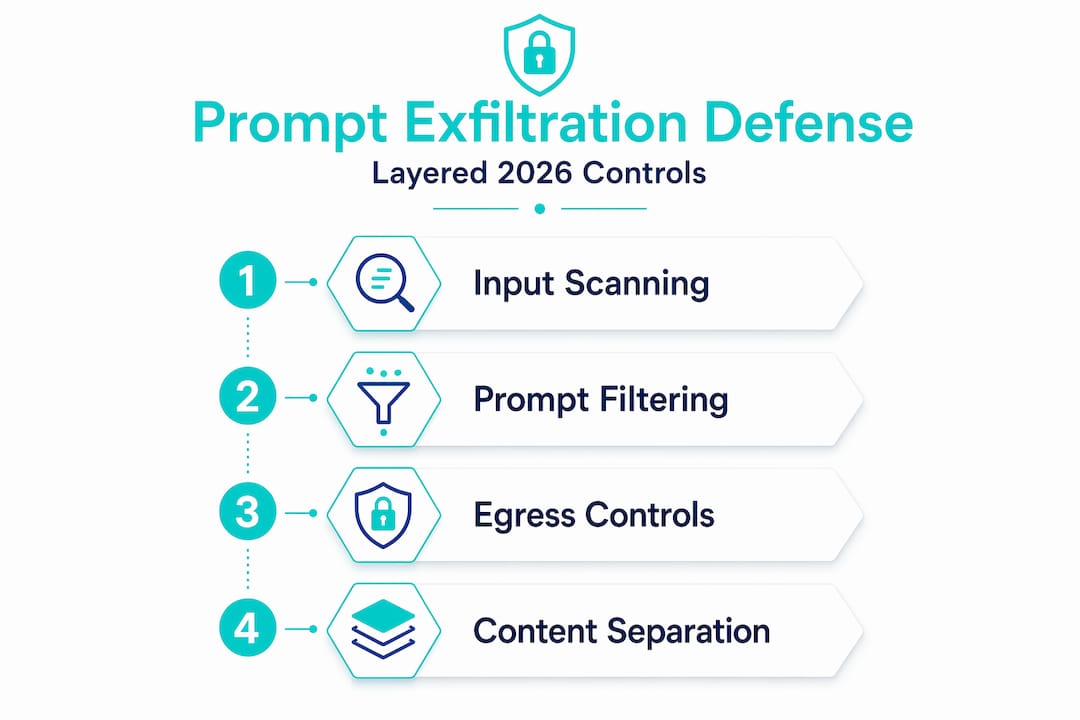
Effective mitigation requires layered controls applied at multiple points in the AI interaction pipeline. No single control is sufficient. The following framework addresses the key intervention points.
-
Input scanning and prompt classification. Before any content reaches the model, classify and scan it for injection-like patterns. This includes uploaded files, pasted code, and retrieved documents in RAG pipelines. Flag instruction-like strings (imperative verbs, URL construction patterns, encoding commands) appearing in untrusted content flows.
-
Output filtering for anomalous patterns. Monitor AI-generated outputs for URLs containing encoded data, Base64 strings, unusual query parameters, and markdown image tags pointing to external domains. This is a necessary control but not sufficient on its own, given that LLMs can generate novel URL structures that evade static filters.
-
Rendering boundary controls. This is the most underutilized control in most enterprise deployments. Proxying or sanitizing markdown image URLs closes the zero-click exfiltration channel that output filtering misses. Implement an image proxy allowlist so that only pre-approved domains can be fetched by the AI interface’s renderer.
-
Architectural separation in agentic AI. Separate reader and writer capabilities in agentic AI architectures. A tool that reads external content should not have write access to outbound communication channels. Scope tokens and API credentials to the minimum required capability, and filter tool outputs for injection-like content before feeding them back into the model’s context.
-
User confirmation workflows. For high-risk actions (sending emails, making API calls, accessing sensitive file stores), require explicit user confirmation before the agent proceeds. Google Workspace’s continuous mitigation approach uses deterministic controls including URL sanitization and user confirmation, reporting measurable reduction in attack success rates without significant efficiency loss.
| Control layer | Mechanism | Threat addressed |
|---|---|---|
| Input scanning | Classify prompts and uploaded content for injection patterns | Direct and indirect prompt injection |
| Output filtering | Monitor for encoded data, anomalous URLs, markdown image tags | URL-based and markdown exfiltration |
| Rendering boundary | Proxy and allowlist external image/resource fetches | Zero-click markdown image exfiltration |
| Agentic architecture | Separate read/write capabilities, scope tokens | Tool-result injection and privilege escalation |
| User confirmation | Require approval for high-risk agentic actions | Automated multi-step exfiltration chains |
Combining prompt filtering with strict egress policies and structural separation of trusted versus untrusted content flows is the current practitioner consensus for robust exfiltration mitigation. Point fixes like URL sanitization can rapidly reduce the attack surface while longer-term model hardening is developed.
Advanced and emerging exfiltration methods to watch
Beyond the well-documented URL and markdown vectors, several emerging exfiltration methods challenge current defense models and deserve attention from security teams building AI incident response capabilities.
-
Tool-result injection at scale. As agentic AI frameworks process larger volumes of external content autonomously, filtering instruction-like strings in tool outputs becomes operationally difficult. Attackers are increasingly embedding injection payloads in web pages, GitHub repositories, and public documents specifically to target AI agents that index or summarize external content.
-
Poisoned RAG documents. Retrieval-augmented generation workflows that pull from internal knowledge bases are vulnerable when an attacker can write to those knowledge bases, even indirectly. A poisoned document in a shared drive, when retrieved and processed by an AI agent, can trigger exfiltration of co-retrieved sensitive documents.
-
Memorization-based exfiltration. This vector operates independently of prompt injection. Models can reproduce sensitive training data without explicit input prompts, a risk demonstrated at gigabyte scale by Nasr et al. (2023). This requires output-side DLP controls even in the absence of any injection attempt.
-
Zero-click browser rendering. The combination of markdown rendering in AI chat interfaces and automatic browser resource fetching means that exfiltration damage can occur during automatic resource fetches, invisible to both the user and most security monitoring tools. The user never clicks a link. The browser fetches the attacker’s URL as part of rendering the AI’s response.
-
Behavioral detection as a necessity. Because these advanced vectors often leave no signature-matching footprint, behavioral analytics become the primary detection mechanism. Establish baselines for normal AI agent behavior (typical external domains contacted, volume of outbound API calls, frequency of file reads) and alert on deviations. AI incident response is a specialization that requires different runbooks than traditional data breach response.
My take on where conventional AI security thinking falls short
I’ve watched security teams build prompt filtering pipelines with genuine care and then discover that an attacker bypassed the entire control by embedding a payload in a PDF that the AI was asked to summarize. The focus on filtering what goes into the model, while neglecting what the model does with retrieved content, is the most consistent gap I’ve seen in enterprise AI security programs.
The uncomfortable reality is that prompt injection is not a bug you can patch out of a language model. It is a consequence of the model’s core capability: following natural language instructions. Every defense that relies solely on detecting malicious instructions at the input layer is, by definition, incomplete.
What actually works is controlling the consequences of a successful injection. If the model cannot reach an external URL, markdown image exfiltration fails. If the agent cannot send email without user confirmation, automated exfiltration chains break. If tool outputs are filtered before re-entering the context, tool-result injection loses its escalation path. Defense in depth here means accepting that some injections will succeed and designing the architecture so that a successful injection cannot complete the exfiltration chain.
The arms race will intensify as AI tools become more autonomous. Security teams that invest in behavioral analytics, rendering boundary controls, and policy engine infrastructure now will be meaningfully ahead of those still debating whether to block ChatGPT at the firewall.
— Next
How Acepaste supports prompt hygiene and injection defense
One attack surface that often goes unexamined is the text itself being pasted into AI tools. Invisible Unicode characters, zero-width spaces, and AI-generated debris embedded in copied text can carry injection payloads that survive even careful manual review. Understanding invisible text in LLM inputs is a prerequisite for any serious prompt hygiene program.
Acepaste Cleaner Pro runs entirely on-device, stripping invisible Unicode characters and AI debris from text before it reaches the model. The Chrome extension auto-scans every page you visit and strips hidden characters on every copy action, removing a class of injection vectors that most enterprise security stacks never address. For security teams building layered AI prompt security controls, clean prompt inputs are a foundational layer. Explore Acepaste as part of your defense-in-depth strategy against AI data exfiltration.
FAQ
What is exfiltration via AI prompts?
Exfiltration via AI prompts is the technique of manipulating an AI model’s inputs or retrieved context to cause the model to encode and transmit sensitive data through a covert channel such as a URL, markdown image tag, or API call. OWASP classifies this under prompt injection (LLM01) and sensitive information disclosure (LLM06).
How does indirect prompt injection enable data leaks?
Indirect prompt injection embeds attacker instructions in documents, emails, or web content that an AI agent retrieves and processes. The model follows those instructions without any direct attacker-to-victim interaction, making the attack difficult to detect through conventional monitoring.
Why do traditional DLP tools fail against AI exfiltration?
Legacy DLP tools rely on pattern matching against known data formats. AI-mediated exfiltration transforms sensitive data through encoding or semantic reformatting before transmission, producing outputs that do not match DLP signatures and exit through legitimate HTTPS channels.
What is a zero-click exfiltration attack in AI systems?
A zero-click exfiltration attack uses a markdown image tag in an AI’s response to trigger an automatic browser fetch of an attacker-controlled URL. Sensitive data encoded in the URL is transmitted without any user action, making it invisible to both the user and most security tools.
What is the most effective defense against AI prompt exfiltration?
No single control is sufficient. The most effective approach combines input scanning, output filtering, rendering boundary controls (proxying external image fetches), architectural separation of read and write capabilities in agentic AI, and user confirmation workflows for high-risk agent actions.
Recommended
- The Invisible Text You’re Pasting Into Your LLM — AcePaste Cleaner Pro
- Privacy Policy — AcePaste Cleaner Pro
- Remove Invisible Unicode & AI Debris from Text — AcePaste
- FAQ — AcePaste Cleaner Pro
I write, research, analyze, and build systems at twl.today, with a focus on cognitive and technical attack surfaces in sociotechnical systems — the seams where human attention, machine processing, and invisible mechanisms diverge.
— B. Greenway